Netherton Foundry Shropshire

Netherton Foundry Shropshire
Classic cookware, made in England
Showing posts with label Cake. Show all posts

Wednesday, 30 December 2020

Citrus and syrup soaked sponge

 A festive treat, aglow with citrus.  This is a light sponge, with oil and yogurt,rather than butter, gluten free and dripping with boozy, zesty orange syrup.


60g Greek yogurt
60ml rapeseed or sunflower oil
2 eggs, separated and whites whisked to stiff peaks
2 oranges, zest grated and juice, errr juiced!
120g sugar
60g ground almonds
60g rice flour

2 tblsp sugar
2 tblsp rum/Cointreau, liqueur of choice (optional)

Heat the oven to 180ºC

Put the oil, yogurt, egg yolks, orange zest and 120g sugar in a mixing bowl and whisk together.

Fold in the flour and almonds, followed by the whisked egg whites.

Spoon the mixture into the prepared tin and bake for 20 - 25 minutes, until golden and firm to the touch.

While the cake is baking, put the sugar into a saucepan and warm gently until golden brown. Carefully add the orange juice and keep stirring until the sugar has dissolved into the juice to form a thick syrup. Remove from the heat and add the booze.

Pour the syrup over the warm sponge and allow it to cool in the tin.

Carefully turn it out and serve with creme fraiche, clotted cream or ricotta, stirred through with candied peel.


Netherton Foundry Shropshire 2020 ©

www.netherton-foundry.co.uk


Thursday, 1 October 2020

A pear cake for Autumn

 Pears, a most perplexing and petulant fruit; one day they are hard enough to knock someone out at 100 paces, the next they are the fruit equivalent of a tumbling toddler - soft, squidgy, bruised and in need of immediate attention.

And so it was that the 2 pears that had been ripening gradually in our fruit bowl, suddenly accelerated towards fruit fly Heaven and were caught at the very last moment.

Too soft for poaching in red wine or lemon and cinnamon scented sryrup, too little space in the freezer for a granita, so they headed into a cake.  And, quite frankly, I think this is the best cake of 2020, so far.


120g butter
120g soft brown sugar
90g marmalade - I uised home made, but if you don't have homemade, try to use one that is not overly sweet.
2 eggs
120g self raising flour
4 tsp of ground ginger (more or less to taste)
2 large ripe pears, cored and chopped (no need to peel, although you can if you wish.  Mine were beyond the point at which peeling was an option)

Heat the oven to 170ºC and grease a 1lb loaf tin

Beat together the butter, sugar and marmalade until very light, then add the eggs and beat again, as hard as you like.
Fold in the flour and ginger and finally, the chopped pears.
Spoon the mix into the loaf tin and bake for around 40 minutes, until a skewer poked into the centre of the cake comes out clean.
If the top of the cake is browning too quickly, cover with a piece of foil, baking parchment or a discarded butter wrapper.

Leave aside until the tin is cool enough to handle without an oven glove and then turn the cake out onto a cooling rack.
When cool, dust with icing sugar and tuck in.

Whilst nice on its own, I reckon this would also make a good dessert with ice cream, whipped cream or yogurt.


Netherton Foundry Shropshire 2020 ©

Tuesday, 11 February 2020

New shape, new recipe - loaf tin cake

You may have noticed that we have changed the shape of our 1lb (½kg) and 2lb (1kg) loaf tins.
This is response to a number of requests from people who love the characteristics and performance of the tins, but who wanted the shape to be more like a sandwich loaf.
So we obliged.  In every respect, other than the squarer shape, these are just the same as the old ones.  So, the same made to last appeal, natural non stick properties, heavy black iron material for great cooking characteristics and wonderful crusts; just as useful, equally beautiful.


And to prove the point, here is a recipe cooked in the new 1lb loaf tin

120g butter
50g sugar
50g lime marmalade*
2 eggs
50g dried cranberries
120g self raising flour.

80g icing sugar
Juice of half a lemon

* I used home made lime marmalade, which is what you would describe as "soft set".  If you use a well known brand such as Roses, which has a much firmer set, then I would advise adding the juice of a lime or a couple of tablespoons of milk to the mix to loosen it a little.

Pre-heat the oven to 170ºC and lightly grease your loaf tin.  This would also work in our cake tin, but you may need to reduce the cooking time. 
Cream the butter, sugar and marmalade together until well blended and light in colour.  Beat in the eggs.
Fold in the flour and the cranberries and spoon the mixture into the greased loaf tin.
Bake for 30 minutes and check that it passes the skewer test.  If the top is browning too quickly, cover lightly with foil or a used butter wrapper.

Leave in the tin for around 10 minutes and then turn out on to a cooling rack.

Put the icing sugar into a bowl and gradually add the lemon juice until you have a thick icing.  Drizzle artistically over the top of the cake. 

Pop the kettle on and make a cup of tea, to be enjoyed with a thick slice of cake.

Netherton Foundry Shropshire 2020 ©


Thursday, 26 September 2019

Chocolate and fig cake

As I have said before, figs are the Marmite of the fruit world; people either love them or hate them.  We fall in to the love camp, the two haters here being the junior Nethertons, now enjoying (semi) independent lives in fig free environments.
Never immune to a bargain, I bought a stash of figs when they were on offer at less than 10p each in our local Tesco earlier this week.
Two dozen of the purple beauties were gently poached in a syrup flavoured with orange sugar
Some were eaten for breakfast with yogurt, a couple were eaten with rye bread and blue cheese and eight of them have been added to a chocolate and rosemary cake.


Start by gently poaching eight figs in a little water, with a couple of teaspoons of honey or sugar.

Pre-heat the oven to 180ºC
Grease a 9" savarin ring.  You could make this in a cake tin, but you may need to use your skill and judgement to adjust the cooking time.

70g 60% dark chocolate
60ml olive oil
60g natural yogurt ( I used Greek)
120g sugar
2 eggs
1 tsp finely chopped fresh rosemary
120g self raising flour

Melt the chocolate, either in a microwave (sorry, absolutely no idea, we haven't got one!) or in a bowl over hot, not boiling water.
Whisk together the oil, yogurt, sugar and eggs.  Add the melted chocolate and rosemary and mix thoroughly. Stir in the flour and pour the mixture into the prepared tin.
Arrange the figs evenly around the cake and place in the oven.
Cook for approximately 35 minutes until it passes the skewer test.

Leave to stand for 10 minutes before turning out onto a cooling rack.  Place a plate under the rack to catch any dripping fig juices.
Whilst still warm (but not hot), invert on to a serving plate, decorate with rosemary sprigs and serve with cream of yogurt.

Netherton Foundry Shropshire 2019 ©


Monday, 2 September 2019

Plum cake

I promised you plum cake and here it is.
No, not the plum pudding of Victorian novels and Christmas past, but a light sponge, studded with pistachios and topped with yellow mirabelles, foraged from a Shropshire hedgerow, as a counterbalance to the sweet cake.


125g butter
125g sugar
2 eggs
1 tblsp plum jam - last year's egg plum jam here!
1 tblsp Greek or natural yogurt
50g shelled pistachios
350 g stewed, sweetened plums - add sugar to suit your own palate.


Gently poach 350g plums and sweeten to taste (Don't overdo it, the tart contrast with the sweet cake is a joy).


Pre-heat the oven to 170ºC and lightly grease a 10" prospector pan.
Cream 125g butter with 125g sugar until light and fluffy.
Beat in 2 eggs and then stir in 1 tablespoon of Greek yogurt and another one of plum jam (we used some of the jam from last year's plum harvest), with 50g of chopped pistachios.
Fold in 125g self raising flour.
Spoon the mixture into the prospector pans and level off with a knife. Spread the cooked plums over the top of the mixture and place into the oven.
Cook for 25-30 minutes, until it passes the skewer test.


Serve warm with cream or yogurt.


Netherton Foundry Shropshire 2019 ©

Monday, 13 May 2019

Orange and thyme syrup cake

Zesty and zingy, this is moist, syrup drenched, gluten free cake to be eaten as an indulgent pudding.


2 eggs
120g butter, melted 
120g + 30g sugar
Grated zest and juice of 1 orange
Small sprig of fresh thyme
60g polenta
60g ground almonds
A slug of orange booze (optional)

Pre-heat the oven to 170ºC
Line the base of a cake tin with greaseproof papaer or baking parchment.  This is a fragile, friable cake and this will help to turn it out.

Whisk the eggs until light and fluffy.  Stir in the melted butter, 120g of sugar and the orange zest.
I used some orange scented sugar to boost the citrus hit.  Next time you peel an orange, place the peel straight into a jar of sugar and store in the cupboard.  The peel will slowly release its oil into the sugar, making it perfect for baking, sweetening poached rhubarb and perking up a meringue.
Fold in the polenta and ground almonds and spoon into the cake tin.
Bake for about 25 minutes, until firm to the touch and golden brown.

While the cake is baking, mix the orange juice with the remaining sugar and, if using, the booze.  I had a bottle of Seville orange and clove vodka to hand, which was just perfect, but Cointreau would be a good substitute.

Remove the cake from the oven and drench in the syrup - the sugar will form a crunchy crust on the cake.

Serve with something creamy, like Greek yogurt, double cream or Mascarpone.

Netherton Foundry Shropshire 2019 ©


Sunday, 13 May 2018

Rhubarb, golden syrup and ginger cake

A lot of fuss is made of the beautiful, pink, forced rhubarb from the Yorkshire rhubarb triangle.  More especially perhaps in these days of Instagram, its blush so photogenic, the colour "popping" on the screen.

But I think I prefer the thicker, greener stems of field grown rhubarb, with its astringency and bite.  Of course, it does need to be tempered with sugar, I defy anyone to tell me they like unsweetened rhubarb, even in savoury dishes.  It also combines joyfully with other flavours; rhubarb and strawberry crumble is a firm favourite here.

This cake is a variation of a much loved steamed sponge and is a light and luscious foil for the tart rhubarb topping.


2 long sticks of rhubarb
Sugar to taste
120g butter
120g golden syrup
2 eggs
120g self raising flour
1 tblsp ground ginger

Heat the oven to 180ºC
Cut the rhubarb into thumb sized pieces and place in an oven proof dish.  Sprinkle liberally with sugar, you will have to decide for yourself how much you need, I used a couple of tablespoons.
Place in the oven for about 20 minutes until it is soft, but still holds its shape.

Set aside while you make the cake mix.
Lightly grease a 22cm cake tin 
Beat the butter and golden syrup together until light in colour and thoroughly combined.
Beat in the eggs.  Really beat in the eggs, then beat a bit more.
Fold in the flour and ground ginger.
Spoon the cake mix into the prepared tin and level it.
Carefully place the cooked rhubarb on top of the cake mix and put the tin into the oven.
Cook for 20 - 25 minutes, until a skewer inserted into the middle of the cake comes out clean.
Serve at room temperature with cream or ice cream.

Netherton Foundry Shropshire 2018 ©


Sunday, 11 February 2018

Apricot cake

A scrumptious, scented apricot cake, which makes a great dessert.
It's reassuringly simple to make, but the inclusion of the rosemary and lemon lifts it out of the ordinary and the Mascarpone gives it a luscious moistness, lending itself to dessert status. 
Of course, you could just eat it with a cup of tea, I think Earl Grey would be particularly complimentary.
However you choose to indulge, I am sure you will enjoy this.


150g soft dried apricots
50ml dry sherry
2 strips of thinly pared lemon zest
1 sprig of rosemary

Put everything into a small pan and simmer gently until all the liquid has been absorbed by the apricots.
Discard the rosemary and lemon zest and set the apricots aside to cool.

120g butter
120g sugar
70g Mascarpone
70g ground almonds
40g self raising flour
½ teaspoon vanilla extract
2 eggs
Handful of flaked almonds.

Pre-heat the oven to 170ºC
Grease and flour an 8½" cake tin.
Chop the cooled apricots.  Beat the butter, Mascarpone and sugar until light and fluffy, then add the eggs and vanilla and continue beating thoroughly.
Stir in the flour, ground almonds and chopped apricots.
Spoon into the prepared cake tin and spread evenly.  Scatter the flaked almonds evenly over the top of the cake.
Place in the oven and cook for 20 minutes, or until a skewer comes out clean.


Leave to cool for 10 minutes, then turn out of the tin and serve with more Mascarpone or better still, some clotted cream.


Netherton Foundry Shropshire 2018 ©
www.netherton-foundry.co.uk


Monday, 23 October 2017

Apple and ginger cake

There is already a recipe for Ginger Apple Topsy, way back when, on this blog, so my love of this particular combination is already on record.
This recipe however, will work just as well without the ginger, if you are not a fan.


When Storm Brian had blasted his way through our apple trees, I collected all the windfalls and, as many of them were somewhat bruised by their encounter with bully Brian, I needed to use them up quite quickly.
A significant number of them were simply washed and chopped and thrown into my largest pan, covered with water and simmered until really soft.
I then passed the whole sloppy panful through a cheesecloth and we enjoyed some deliciously fresh and fruity juice, leaving  behind a bowl full of apple pulp, along with some disconnected skins.
Normally, I would push this through a sieve, collecting any pips, cores and skins and creating the smoothest of smooth apple smoothiness... ie purée, not unlike Heinz baby food to be honest.
On this occasion, I didn't bother. I simply discarded any pips and blitzed the skin during the cake mixing process.  HOWEVER, if you are planning on making this cake by hand, rather than in a processor, I strongly recommend some sieve action or a quick blitz with a stick blender before you use the fruit pulp.

120g butter
120g brown sugar
120g apple pulp or purée
25g crystallised ginger, optional
1 dessertspoon golden syrup
2 eggs
120g rye flour

Pre-heat the oven to 175ºC
Chop the crystallised ginger into pretty small pieces and put into a food processor with the butter, brown sugar and syrup.  Mix until much lighter in colour and thoroughly well blended.
Add the eggs and apple pulp and mix well.
Add the flour and process until just incorporated into the mix - do not over beat at this stage.
Grease a 9" Savarin ring and dust with flour.  Tip out any excess.
Spoon the mixture into the ring and spread out evenly.

Bake for approximately 25 minutes.  The cake is ready when it springs back to the touch or a skewer inserted into the centre of the mix comes out clean.
Remove from the oven and leave to stand for 5 minutes, then turn out onto a cooling rack.
We ate this "au naturel", but I reckon that a drizzle of lemon glacé icing might make a nice finishing touch, if you're showing off.


Netherton Foundry Shropshire 2017 ©


Thursday, 5 October 2017

The voluptuousness of figs

Indifference is not a word you can associate with a fig. The take it or leave crowd are not at home to receive this luscious offering, it's more of a Marmite than a national treasure.  We are divided in the Netherton household; one half of us love them and the other half would rather they didn't exist.


From the smooth, purple suede-like skin to the sensual magenta flesh there is something utterly shameless about a fig.
Favouring many partners, from Parma ham, to lamb, blue cheese and goat's cheese, the fig is truly a slut of a fruit.

This recipe, designed to show off our blini pans and made in small quantities for the fig lovers here, pairs them with honey, thyme and walnuts, with a splash of red wine to add to the wantoness.


4 figs

1 tablespoon runny honey
4 small sprigs fresh thyme
2 tablespoons of red wine

Pre-heat the oven to 170ºC

Make a cross cut in the figs, without going through to the base.
Place the figs in a 1lb loaf tin or an oven proof dish.  Place a sprig of thyme in the centre of each fig, drizzle over the honey and add the red wine to the tin.
Place in the oven and roast the figs for 15 minutes.
Remove from the oven and set aside...... leave the oven switched on.

2oz butter

2oz sugar
2oz self raising flour
A handful of walnuts
1 egg
Grated zest of half an orange

Cream the butter, sugar and orange zest together until very light in colour.

Place a tablespoon of the flour into a mortar, add the walnuts and grind coarsely.
Beat the egg into the creamed butter mix and then fold in the flour and the crushed walnuts.

Lightly grease 2 blini pans -  if you haven't got blini pans, use Yorkshire pudding trays.

Spoon the mixture evenly into the pans.  Gently press 2 of the roasted figs into each tin and pour over the gooey wine syrup from the roasting tin.  You can scatter on some chopped walnuts and a few thyme leaves if you wish.


Place in the oven and cook for 15 - 20 minutes.

Leave to cool for around 10 minutes,then carefully remove from the pans, using a palette knife, and place them on a cooling rack.  
Serve at room temperature with a dollop of Greek yogurt.


Netherton Foundry Shropshire 2017 ©


Sunday, 16 July 2017

Inspired by a bee

We have some rampant lavender bushes in the garden, planted alongside some beautiful David Austin roses.  Together with the jasmine, honeysuckle and dianthus, these scent the warm evening air to an intoxicating degree and provide us with a summer long supply of cut flowers for the kitchen table.


Whilst providing an olfactory overload for us humans, they also attract all manner of bees and the sound of them buzzing their busy way around the stems is mesmerising and soothing.  As long as I can hear the bees I feel that whatever else is going on around the globe, in this small corner at least, all is right with the world.  There may even be hope for the rest of it.
The bees were particularly active earlier this week, when the sun was warm and the air still and it took ages to capture one of the busy bees bumbling around the flowers.


But as I waited patiently for the moment to click, I pondered the combination of lavender and honey and, having captured this fat fellow's picture, headed back into the kitchen to experiment.

Coming up with the idea of a honey based, lavender scented syrup, I decided on a denser style of cake, which would be drenched in the syrup and served as a dessert.

This also happens to be gluten free and you could quite easily double up the quantities and make a thicker cake, if you wished..... just turn the oven down by 20ºC and cook for a further 15 minutes.

For the cake
120g butter
120g sugar
2 eggs
60g polenta
60g ground rice
2 dstsp creme fraiche

For the syrup
100ml water
3 dstsp honey
8 lavender heads

Pre-heat the oven to 180ºC
Grease a cake tin and dust with polenta.  Tip out the excess (you can add this to the polenta you are weighing out for the cake mix).

Cream the butter and sugar vigorously, until very pale in colour.  Add the creme fraiche and beat again.
Add the eggs and mix thoroughly - don't worry too much if it separates.
Fold in the polenta and rice flour.

Spoon the batter into the cake tin and spread out evenly.
Place in the oven and cook for 20 - 25 minutes, until a skewer, inserted in the centre of the cake comes out clean.

While the cake is cooking prepare the syrup.
Put water, honey and lavender in a pan, (our milk pan or 6" saucepan is ideal) heat slowly until honey is fully dissolved.


Bring to the boil and reduce by half.
Strain and set aside.

When the cake is cooked, pierce it all over with a skewer or fork.
Pour over the honey syrup, while the cake is still hot.
I strewed the top of my cake with lavender petals, thyme and hyssop, but a plain top is perfectly acceptable.


When the cake has cooled, gently turn out of the tin onto a plate and then invert onto your serving dish.  This pretty plate is from 1265 degrees north and the flower petals are from our garden.


Serve with a generous spoonful of creme fraiche and I reckon a few raspberries wouldn't go amiss.


A note of caution; flower petals are a very simple way of making your dishes look pretty and summery, but please, please make sure that the ones you pick are edible!!  

© Netherton Foundry 2017 ©


Sunday, 18 June 2017

Our new cake tin is put through its paces


Someone called the workshops last week and asked whether we had a rep visiting their area in the near future.
The short answer was, "No", but to expand on this brevity.... we are a small, family business and when you call you deal directly with us. You can talk to Neil, the creative genius and founder of Netherton Foundry, father of my children and all round superhuman and you can talk to me.  
We do not have reps and agents schlepping around drumming up business for us - that's not how we do things.
When Neil created the first Netherton Foundry, made in Britain product -  our slow cooker - there was nothing else for it than for me to fill my "little blue van" and tour the length and breadth of the country, hammering on shop doors.
Not being a natural front of house/sales person, with a lifetime of back room jobs behind me I found this new role, shall we say, challenging. However, with no-one else to do it, I simply had to get on with it - what doesn't kill you makes you stronger!!
To start with, I was quite frankly terrified and rubbish.  But as the trips and the miles accumulated, so did my confidence, market knowledge, sales and "technique".  
I covered a lot of ground, quite literally, and met many people.
Of the rude, arrogant, ignorant and hostile, the less said the better.
Of the inspirational, imaginative, supportive, kind, tea offering and friendly majority, no praise is high enough and my thanks to all of you are implicit here.... you know who you are.
I learned a lot of valuable lessons and have a store of anecdotes, with which I occasionally bore anyone who will listen.

My personal armour, donned to protect me, in part, from the aforementioned hostile crowd, and polished to bolster my confidence, was double skinned; my passion for what we had started and personal knowledge of the product.
I simply refused to sell anything we hadn't tried and tested ourselves.
Cliché it may be, but I spoke from the heart.
For example, before the milkpan was made available to you lot, one came home with me.  Its first run was a batch of porridge, and when it had been successfully and easily cleaned out, it had to face a helping of scrambled egg followed by a pint of custard.  Product testing can be hard at times, imagine having to eat a pint of creamy, home made custard and call it work!
Incidentally, that's how the milkpan ended up with 2 pouring spouts - our son is left handed and accused us of right hand prejudice when he tried out the pan.

The latest Netherton Foundry equivalent of a "shiny new thing", which naturally isn't shiny at all, is our cake tin and this was tested with the same ruthlessness as everything else.
No paper lining and the stickiest substance in the cupboard were the starting point.
And this is what happened................. this was not a special tin, nothing extra had been done to it, it came out of the seasoning oven, had its brass rivet added and was unceremoniously bundled onto the front seat of my slightly newer little blue van.

Honey, date, walnut and lavender cake.
120g butter
50g broken walnuts
120g honey
70g chopped, pitted dates
2 eggs
170g self raising flour 
2 lavender heads, chopped (optional and you can substitute fresh thyme if you prefer)
3 teaspoons runny honey.

Pre-heat the oven to 170ºC.
Grease your cake tin - as my mother before me, I use the wrapper from a pack of butter - and dust with flour.  Tip out any excess flour.
Put the honey, butter, dates and walnuts into a pan, our milk pan is ideal.
Warm over a gentle heat until the butter has melted.
Leave to cool while you whisk the eggs in a large mixing bowl until light and fluffy.
Pour the butter mix into the eggs and whisk again.
Fold in the flour and lavender/thyme (if using) 
Pour the batter into the  greased and floured cake tin.
It looks like porridge at this stage - don't worry!


Place in the oven for 20  - 25 minutes, you can tell it's cooked if a skewer inserted in the centre of the cake comes out clean

Drizzle top with 3 tsp runny honey while still warm.
Allow to cool in tin and then turn out carefully.  You will get sticky hands, but hey, what's the problem with that?  Lick your fingers.

This can be served plain with a cup of coffee or dressed up with, say, caramelised or puréed apple and a dollop of Mascarpone.


© Netherton Foundry 2017


Monday, 12 June 2017

White chocolate and raspberry cake

No rambling, no proselytising, just a fab new recipe, of which I am extremely proud.


120g sugar

2 eggs, separated
1/2 tsp vanilla paste
120g rice flour
100g white chocolate, melted and cooled
120g stracciatella yogurt, you can get big tubs of this in Lidl 
120g raspberries

Pre heat the oven to 180ºC
Whisk the egg yolks, sugar and vanilla extract until very pale.
Add the yogurt (use plain, vanilla, lemon or coconut if you can't get/don't like stracciatella)
Whisk thoroughly.
Add the cooled, melted chocolate and whisk again - it will feel a little stiffer now as the chocolate cools.
Whisk the egg whites until they form peaks.
Fold the rice flour and the whisked egg whites into the chocolate batter.

Pour into a greased 10" prospector pan or one of our new cake tins
Arrange the raspberries in concentric circles on top of the batter..... or if you are feeling anarchic, just scatter them where they fall!


Bake for 30 minutes until golden and a skewer comes out clean.
Leave to cool, then turn out of the pan.

Serve just warm either on its own or with creme fraiche, Greek yogurt, clotted cream or raspberry sorbet/ raspberry ripple ice cream.


© Netherton Foundry 2017
www.netherton-foundry.co.uk


Wednesday, 1 February 2017

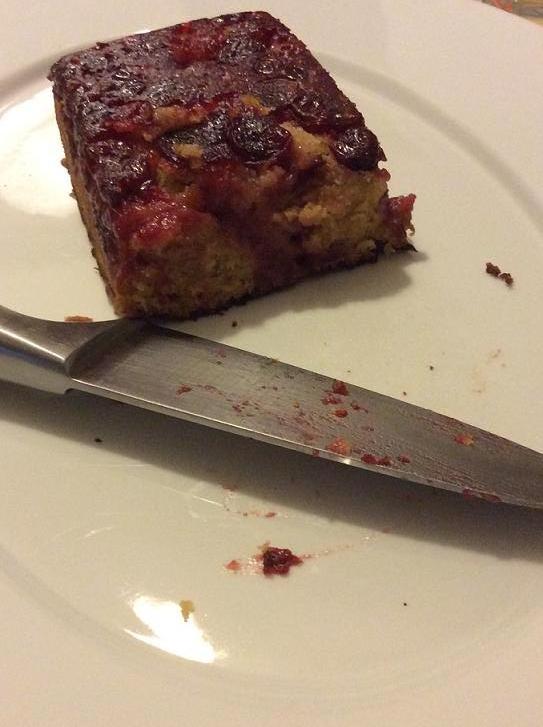
Cranberry and marmalade cake

I have never been one for the type of resolutions that see you having to give up something pleasurable during the grey days of January.  Admittedly the days are technically getting longer, but you'd be hard pushed to admit that that's what it feels like.
There is, I have no doubt, a different shade of grey for every day of the month and yet they all merge into one long, washed out blur of monochromatic misery.  Not quite 50 shades, but let's not go down that road.

It's hard to feel cheerful faced with the monotony of bad, but rarely so bad you can't go to work, weather; the comedown after Christmas, when you no longer have the tree, but the pine needles keep turning up under the sofa, the last of the slightly dodgy chocolates that you received in the secret Santa sack, the sad resignation of not being able to gorge yourself on mince pies for another 10 months, at least;  eating the last slice of Christmas cake; acknowledging that a nice glass of sherry mid afternoon is no longer acceptable; higher heating bills that coincide with the arrival of the Christmas credit card bill. April is most certainly not the cruellest month.

January is not the month to be contemplating fresh starts, it does not live up to the promise of a new year, new start -  more like new year, let's just pull the blankets over our heads and wait for Spring.

But there are reasons to be cheerful - no more bloody trite TV ads for a start and no more celebrities smugly telling us about their perfect Christmas,when we all know that they pay someone else to decorate their tasteful tree, cook their dinner and wrap their overindulgent, social media friendly presents.


Bah humbug indeed.


Mid way through the morning of my day at Otter Farm, Claire presented us with a slice of still warm, marmalade, polenta and thyme cake.  Divine.

I also have my own, slightly different and seasonal marmalade cake, which I shall share with you.
This is a perfect January dish, when you still have cranberries hanging around after Christmas and the first Seville  oranges are in the shops.

I used the last of the cranberry sauce I had made at Christmas, which had been decanted into a jar and stored in the fridge.
You can, of course, use commercially made sauce, but it will be too sweet and sticky without a little adulteration. I suggest that you warm 2 tablespoons of sauce gently over a low heat and add the juice of 2 Seville oranges.
If you want to start from scratch, measure out enough fresh cranberries to cover the base of your loaf tin and then transfer them to a pan. Add the juice of an orange and cook gently until they start to burst and the juice starts to run. Add sugar to taste, but go carefully, this will be the topping for a cake, so don't overdo it or the end result will make your teeth ache.

Pre heat the oven to 180ºC


Weigh 2 medium size eggs, in their shells and then measure the same weight of butter, marmalade and self raising flour.
You will also need ½ tsp fennel seeds, although I know opinion is fiercely divided on this subject, so feel free to omit them if you are not a fan and 2 tablespoons cranberry sauce

Beat butter and marmalade together.  Add the eggs and beat thoroughly.  A food mixer or processor is best for this, you want as much air in the mixture as possible.

Sift in the flour and fennel seeds.

Grease a 1lb loaf tin and spread the cranberry sauce over the base.


Top with the cake mix and spread evenly.


Place in the oven and bake for approx 30 minutes until a skewer inserted in the middle comes out clean.
Leave to stand for 10 minutes

Run a knife around the edge of the cake and invert the tin onto a serving plate.


Serve with creme fraiche, mixed with grated orange zest and a sprinkle of icing sugar, or simply eat as it is with a cup of coffee.

© Netherton Foundry Shropshire 2017